
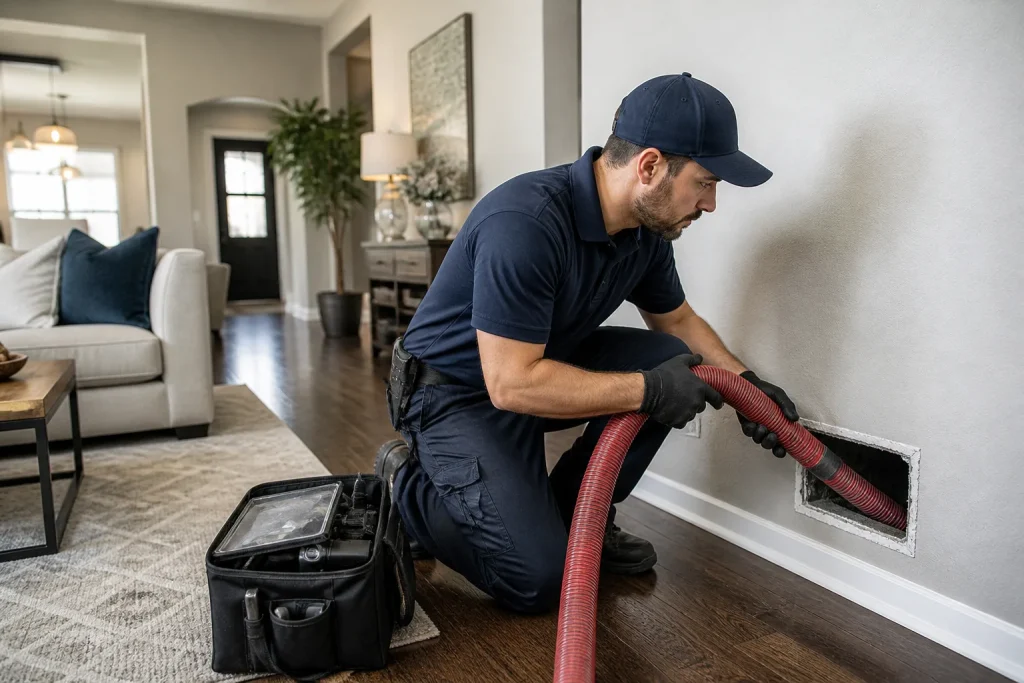
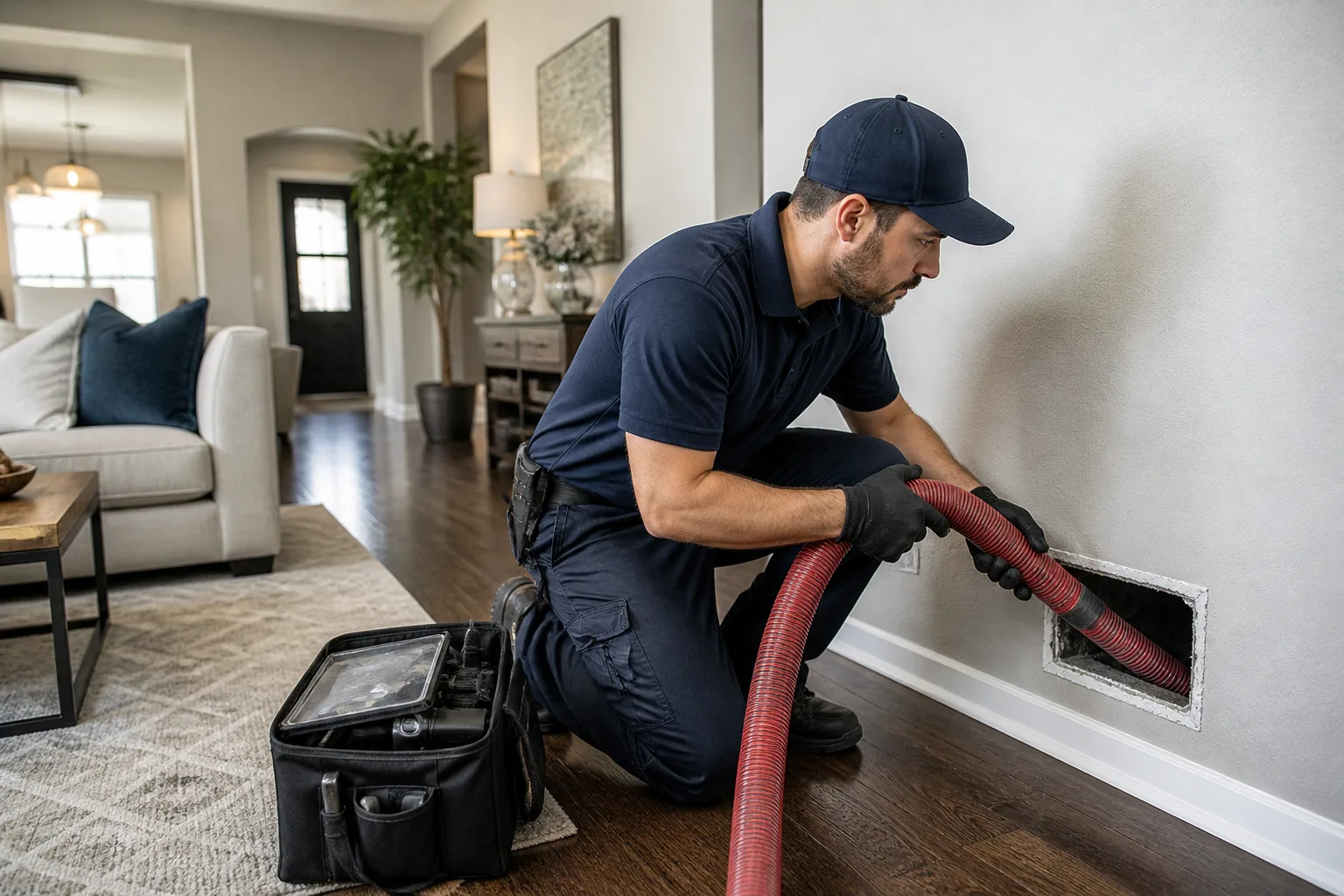
Emergency Air Duct Cleaning Near Me: What Garland Homeowners Should Do First
If you’ve had a fire, a sewage backup, or found mold at your registers, the first move is not to call a duct cleaner. It’s to shut your HVAC system off. Running the system while you wait distributes smoke particles, odor compounds, and spores deeper into the duct liner with every cycle, and that turns a contained problem into a whole-house one. What follows is the order we’d want any Garland homeowner to work through in the first hour, before a technician arrives.
Most of what gets labeled an emergency isn’t one, and some things that sound minor are. Sorting that out early saves you money and, in the mold and sewage cases, keeps you from spreading contamination you can’t get back. If you’d rather have someone walk through it with you, call (888) 430-9938. We answer 24/7. Fast dispatch from 7am to 7pm, Sunday through Friday.
What Actually Counts as a Duct Cleaning Emergency in Garland?
An emergency is any condition where your HVAC system is actively moving contamination, moisture, or pathogens into living space. Smoke and soot residue after a fire is one. Sewage that has backed up into a drain pan or air handler is another. Confirmed mold growth at multiple supply registers is a third. Everything else is urgent-but-not-emergency: musty smells, a dusty register, an inspection flag, a dryer vent that takes two cycles.
The distinction matters because emergencies call for a containment-first sequence and often a remediation assessment before cleaning, while urgent situations can be scheduled as normal service. Here’s how we sort the two in Garland homes:
- Emergency: fire or smoke residue in the system, sewage contact with the air handler or ductwork, visible mold at more than one register, standing water inside ductwork after a storm.
- Urgent, not emergency: persistent musty odor with no visible growth, a single damp spot near one register, a home inspection note, high dust after nearby renovation.
- Routine: seasonal maintenance, allergy-season cleaning, pairing duct cleaning with a filtration upgrade.
If you’re in Garland and aren’t sure which bucket you’re in, describe what you’re seeing and smelling on the phone. That conversation costs nothing and it tells us what equipment to plan for.
First-Response Checklist: The First Hour
Work through this in order. It’s the same sequence we’d follow on arrival, and doing it before we get there protects your home and your insurance claim.
- Shut the HVAC system down at the thermostat. Set it to off, not to fan. Fan-only mode still moves air through the ducts and still spreads contamination.
- Identify the source. Was it a kitchen fire, a dryer fire, a sewage backup, roof or plumbing water intrusion, or something you can’t pin down? Write down what you know while it’s fresh.
- Document everything. Photograph the affected registers, any staining on ceilings or walls near the air handler, and the thermostat setting. Photographs taken before any cleaning are the ones insurance adjusters want.
- Contain what you can. Close doors to unaffected rooms, keep people and pets out of the affected area, and don’t run ceiling fans or portable fans in rooms where soot or mold is present.
- Call your insurer before you call a cleaner if the source was a fire or water event. Ask what they want documented and in what order. Some policies require remediation assessment before cleaning; doing it backwards can complicate the claim.
- Don’t spray air fresheners or run ozone in the ducts. Covering the odor can hide the evidence an assessment needs.
Once those are handled, the system is stable and a technician can assess it properly rather than chasing a moving problem. For standard, non-emergency jobs, our air duct cleaning service is the right starting place.
Why Some Emergencies Need Assessment Before Cleaning
In sewage and mold scenarios, cleaning first is a mistake. Here’s why. Sewage carries bacteria and other biological contaminants, and standard duct cleaning equipment will dislodge them into the air before it extracts them, especially if the system isn’t already under containment. Mold behaves the same way: agitation sends spores airborne, and if the moisture source is still active, you’re cleaning the same growth back into the ducts.
Both scenarios need a remediation assessment first. That assessment answers three questions: is the contamination active or historic, what’s the moisture source, and what has to be repaired before cleaning makes sense. We repair what we find, and sometimes that means a breached or disconnected duct section has to be sealed before any cleaning matters, because a disconnected run just sends everything into the wall cavity. Air duct repair is a core service for exactly this reason.
For insurance purposes, assessment-first also preserves the paper trail. Photographs, moisture readings, and a written scope of what was damaged and what was cleaned are the record an adjuster works from. Cleaning that happens before that record exists can leave you documenting a problem that’s already gone.
What Equipment a Real Emergency Response Requires
Standard duct cleaning rigs won’t handle fire, sewage, or mold work. They agitate and extract, which is right for routine cleaning but not for containment work. Ask what’s coming to your Garland home before the technician arrives, and expect three things:
- HEPA-filtered negative pressure units. These hold the affected ductwork under negative pressure so loosened particles move toward the machine, not into your living room. If the company can’t name a HEPA unit, they don’t have one.
- A containment setup. We use Abatement Technologies equipment to hold negative pressure and keep contaminants from recirculating during service. This is the step most operations skip, and it’s the one that makes the difference on a real emergency.
- Mechanical agitation and professional extraction. Rotobrush brush systems give mechanical contact with duct walls, and Nikro extraction systems pull a full-system volume rather than surface dust. A residential shop vac on a hose isn’t either of those.
The honest test: ask the company to name the equipment they’ll run and how they’ll maintain negative pressure. An operation that can’t answer that clearly is not equipped for a true emergency, whatever the phone call promised.
Post-Storm and Flooding Scenarios: Extraction and Drying First
When standing water has reached the air handler or ductwork, cleaning is not the first step. Extraction and drying are. Water inside a duct system doesn’t just dry on its own; it sits in the liner and the insulation, raising humidity inside the system and giving mold a foothold within days. The sequence looks like this:
- Shut the system down. Water in the air handler plus power is a hazard in itself.
- Extract standing water from the air handler, drain pan, and any low points in the duct runs.
- Dry the system with mechanical drying before any cleaning begins.
- Assess for damage. Duct sections that held water are checked for separation, sagging, or liner damage. Wetted insulation that can’t be dried gets replaced, not cleaned.
- Clean only after the system is dry and stable.
Garland’s climate is mild enough that winter won’t freeze a duct run, but the warm weather is exactly what makes moisture the concern. A wet system that stays wet in spring becomes a mold problem by summer. That’s why we treat post-storm calls as drying jobs first and cleaning jobs second.
When to Call a Pro
Call when the system is moving anything you don’t want in your air: smoke residue, sewage contact, visible mold, or water. Homeowners can shut the system down and document; they shouldn’t pull registers and start agitating ductwork on a contamination problem, and nobody should climb into or reach into a system where sewage or mold is present. That’s the point where a professional has to step in with the right containment.
If you’re looking for dryer vent cleaning, that’s a separate job and a genuine safety one, since lint buildup in the vent run is a leading cause of residential structure fires. On the air-quality side, we pair cleaning with duct cleaning systems from Honeywell and Aprilaire when filtration or humidity control makes sense as an upgrade, so the ducts and the rest of the system work together.
The Bottom Line
In a duct-related emergency, the order matters more than the company you call. Shut the system down, find the source, document everything, and don’t clean before you’ve assessed. For fire and water events, check with your insurer on documentation requirements before scheduling. For sewage and mold, expect an assessment first. And ask any company what equipment they’ll use, because HEPA negative pressure and proper containment are the line between cleaning that helps and cleaning that spreads the problem.
If you’re in Garland and need help, Duct Cleaning Garland offers free estimates from licensed and insured technicians with up to 13 years of experience. Before-and-after photos of your own ducts are part of every job. Call (888) 430-9938. We answer 24/7. Fast dispatch from 7am to 7pm, Sunday through Friday.
Frequently Asked Questions
No. Keep the system off at the thermostat, including fan-only mode, until it’s been assessed. Running it distributes soot and odor compounds deeper into the duct liner, which makes cleanup harder and can affect your insurance documentation. Call (888) 430-9938 for an exact quote on an assessment, estimates are free.
One register is urgent, not an emergency. More than one, or growth spreading back into the duct, moves it into emergency territory and needs an assessment before cleaning. Either way, shut the system down and photograph what you see first. Call (888) 430-9938 to talk it through.
Often, but only if the damage is documented before cleaning. Photograph the affected areas, call your insurer early, and ask what scope and evidence they need. Cleaning before that record exists can complicate the claim. Call (888) 430-9938 for a free estimate and we can work with your insurer on documentation.
Standard cleaning agitates and extracts dust and debris under normal conditions. Emergency response adds HEPA-filtered negative pressure and containment, plus an assessment step before cleaning in sewage, mold, and water scenarios. We use Abatement Technologies containment gear and Rotobrush and Nikro equipment on the job. Call (888) 430-9938 for a free estimate.
Written by the team at Duct Cleaning Garland.
Need Air Duct Cleaning Help?
Call Duct Cleaning Garland - licensed & insured, here with fast help in Garland.
(888) 430-9938