
How to Choose the Right Air Duct Cleaning Company in Garland
Most homeowners pick a duct cleaning company the way they pick a restaurant: they look at the star rating and the price, then book. That’s a mistake, and it’s an expensive one. A clean Google rating tells you nothing about whether the company owns extraction equipment that can actually pull debris out of your ducts. A crew with a residential shop-vac and a leaf blower can earn five stars too. This guide is a technical vetting framework, built around the questions that separate a real duct cleaning operation from a pressure-washing truck with a phone number.
A quick direct answer: choose a Garland duct cleaning company by verifying equipment capability and process before anyone arrives, not by reviews or price. Ask what extraction system they use, whether it’s truck-mounted or portable, and which agitation tool runs alongside it. If you’d rather skip the homework, call (888) 430-9938 and we’ll walk you through exactly what we use on a job.
Why Reviews and Prices Don’t Tell You Much in Garland
The Garland housing stock ranges from mid-century ranch homes near downtown to newer construction out toward the eastern edge of the city. Duct systems vary wildly across that range: flex duct in some houses, rigid galvanized in others, and plenty of homes where a previous remodel left a disconnected run nobody noticed. A company’s process has to handle all three. Reviews don’t capture that. Price definitely doesn’t.
Here’s the uncomfortable part. NADCA membership and a clean Google rating are both real signals, and a company can hold both while still showing up with a shop-vac. Membership is a commitment to a standard of practice, not proof of equipment. And a low quote is often a quote for a process that doesn’t remove anything from the duct wall – it just moves dust around the system so it settles again in a week.
In our experience across Garland, the single most reliable predictor of a good outcome is what equipment shows up. Everything else is secondary.
What the equipment actually needs to do
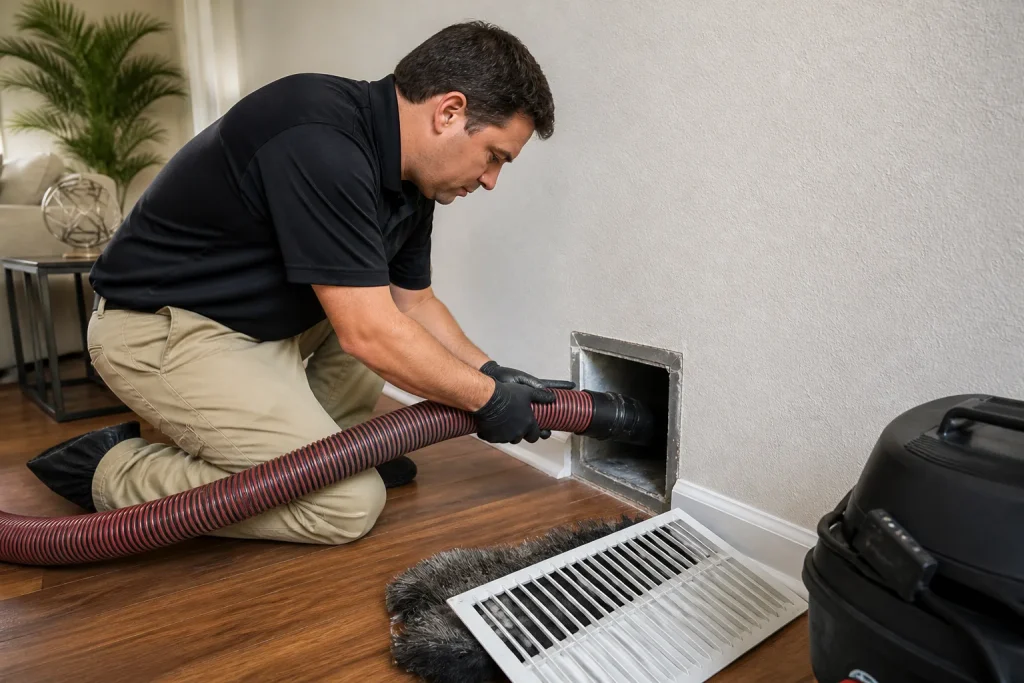
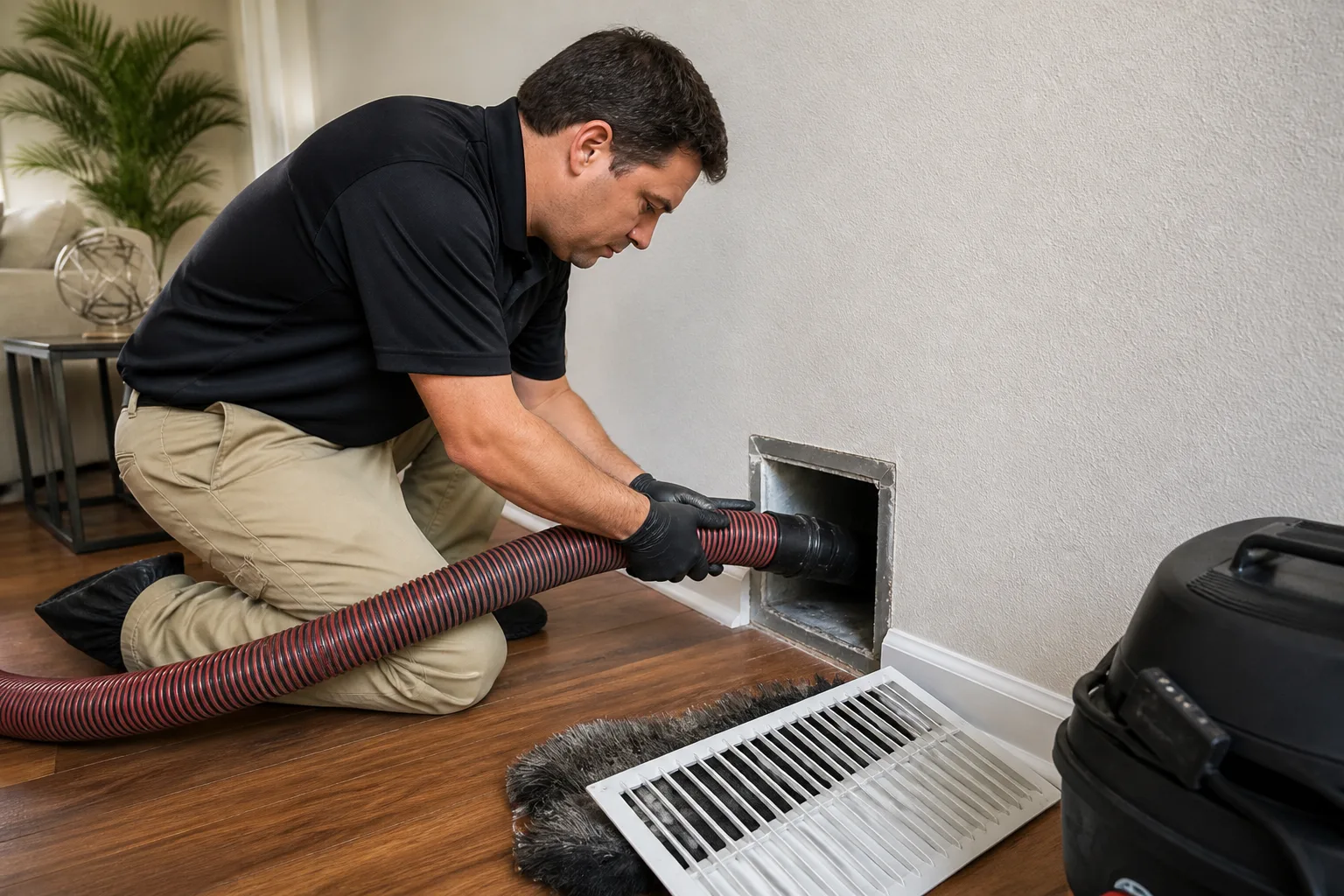
Full-system duct cleaning requires two things working together: a tool that physically agitates debris off the duct wall, and a vacuum with enough suction to pull that debris out of the system and into a containment unit. Miss either one and you’re paying for a partial job. A compressed-air blowout with no extraction is the worst case, because it redistributes dust through the house.
The Pre-Booking Verification Script: Questions to Ask Before You Pay a Deposit
Call and ask these questions before you book. A credible operator answers them without hesitation. A cut-rate crew with a shop-vac either dodges them or doesn’t know what you’re talking about.
- What extraction equipment do you use? You want a specific brand or system. We use Nikro professional HVAC extraction systems – the same class of equipment commercial contractors rely on, not a consumer vacuum repurposed for duct work.
- Is it truck-mounted or portable? Portable units can work fine on many residential jobs, but you want to know which is coming. A truck-mounted unit is generally rated for higher CFM; a portable unit needs enough suction capacity to handle the length of the run and the number of registers in your home.
- What are the CFM ratings on your extraction unit? CFM, or cubic feet per minute, is the measure of how much air the vacuum can move. Ask for the number. If the answer is “it’s very powerful,” that’s not an answer.
- What agitation tool do you use alongside the extraction? Extraction without agitation is a surface vacuum at best. We run a Rotobrush brush system for mechanical contact cleaning, so the brush physically contacts the duct wall and breaks debris loose while the vacuum pulls it out. Compressed air alone leaves material clinging to the walls.
- How do you contain the dust during the job? This is the question most homeowners never ask, and it’s the one that determines how your house smells when they leave. We use Abatement Technologies equipment to maintain negative pressure and containment during service, so loosened contaminants don’t recirculate into living spaces.
- Do you handle repair, or only cleaning? If a run is disconnected or a section is breached, cleaning it thoroughly accomplishes nothing. Ask whether they can locate and seal a break, or whether they’ll hand you a referral.
Writing those six questions on an index card before you call is the whole job. The quality of the answers tells you more than any review page.
NADCA-Certified vs. NADCA-Compliant: What the Difference Actually Means
These two phrases get used interchangeably, and they aren’t the same thing. NADCA stands for the National Air Duct Cleaners Association, the trade body that sets the industry’s standard of practice. Membership means a company has committed to that standard. Certification is a separate, individual credential tied to a person who passed an exam and maintains continuing education.
Here’s why it matters for your decision. A company can advertise NADCA compliance or membership without a single certified technician on the crew. Certification is a knowledge signal – it tells you someone in the organization understands the standard. It doesn’t tell you what equipment gets loaded onto the truck or whether the process on your job will follow the standard. Those are two different questions.
Use certification as one input, not the whole decision. A NADCA-certified operation that shows up with inadequate equipment is still going to leave debris in your ducts. An operator with excellent equipment and a documented process may not hold the certification label at all. Ask about both: credentials and hardware. Garland homeowners who ask about both tend to get much better results.
What a legitimate pre-job walkthrough looks like
A credible technician assesses your system before quoting, not after arriving with a clipboard and a price sheet. The walkthrough should cover:
- Access points – where the equipment can reach the main trunk line and each branch run, and whether existing access panels are adequate or need to be cut.
- Register count – how many supply and return registers the system has, which determines the scope and time of the job.
- Duct material type – flex, rigid galvanized, or ductboard each require different brush heads and pressure settings.
- System condition – visible gaps, disconnected sections, or signs of moisture that change the plan.
If a company quotes your whole system over the phone without asking a single question about your home, that quote is a guess. It’ll change once they’re inside.
Three Bait-and-Switch Patterns Common Among Low-Cost Garland Operators
These are the patterns that turn a $79 ad into a $600 invoice. Knowing them in advance is most of the defense.
1. Per-vent pricing that inflates on-site
An advertised per-vent rate sounds cheap until the technician counts your registers and tells you there are twice as many as the ad assumed. Suddenly the number doubles. A fair quote prices the whole system, not each vent, and it holds. That’s why our pricing is one flat price per system, agreed before work starts, with no per-vent tally at the end.
2. “We found mold” without lab verification
Any technician can point a flashlight into a duct, shine it on a dark patch, and call it mold. Mold identification requires a sample and a lab. If someone tells you there’s mold in your Garland home’s ducts and offers to treat it for an extra fee on the spot, ask for the sample results. If there aren’t any, there isn’t a finding.
3. Pressure washing internal ducts without a drying protocol
Wet-washing duct interiors is a legitimate method in some applications, but it requires a documented drying protocol afterward. Ducts left damp are a far bigger problem than the dust you started with. Ask how they dry the system and how they verify it’s dry before closing up. If the answer is vague, walk away.
What Post-Job Verification Should Look Like
You shouldn’t have to take anyone’s word for it. A reputable company documents the work, and you’re entitled to see that documentation as a standard part of the job – not as a favor.
- Register visual inspection – look into several registers yourself after the crew finishes. You should see clean duct walls, not a fresh coating of dust.
- Before-and-after photos at access points – the same access panel, photographed before and after. This is the simplest proof that the work happened.
- A written summary of what was found – disconnected runs, damaged sections, or areas that couldn’t be reached. If repair is needed, you should know exactly where and why.
Before-and-after photos of your own ducts are the standard we hold ourselves to, and they’re a reasonable thing to ask any company for. The question “how do I know the work was actually done” has a straightforward answer: pictures of your system, taken at your access points, on the day of service.
When to Call a Pro Instead of Waiting
Not every dusty register needs a crew. But some symptoms point to a system problem that won’t resolve on its own. Call a professional if you notice any of these:
- A musty or stale smell that returns within days of cleaning
- Visible dust blowing out of registers right after a filter change
- Allergy symptoms that flare indoors and ease when you leave
- A home inspection report flagging the ductwork
- A dryer that takes two cycles to dry a normal load – that’s a dryer vent cleaning issue with real fire-safety stakes, not a convenience item
- Uneven airflow between rooms, which often points to a disconnected or breached run that needs Garland duct repair rather than another cleaning
If you’re already comparing companies, it’s worth reading up on what air duct cleaning actually involves so you know what the quote should cover. And if you want the full picture of what we do, start at Duct Cleaning Garland.
Related services in Garland
We provide three integrated services under one roof: air duct cleaning, dryer vent cleaning, and air duct repair. If a walkthrough turns up a breached section, we repair what we find rather than handing you off to someone else. We also work with Honeywell and Aprilaire systems, so if your cleaning turns up a filtration or humidity control gap, that conversation happens naturally rather than as a separate sales pitch.
Key Takeaways
- Equipment capability and process matter more than reviews or price.
- Ask for specific CFM ratings, whether the unit is truck-mounted or portable, and which agitation tool is used.
- NADCA certification is a knowledge signal, not proof of equipment quality.
- A real quote follows a walkthrough: access points, register count, duct material.
- Per-vent pricing, unverified mold claims, and wet-washing without drying are the three most common traps.
- Before-and-after photos at access points are standard practice, not a favor.
The Bottom Line
Choosing a duct cleaning company in Garland comes down to the questions you ask before anyone arrives. Verify the extraction system by name, confirm the agitation tool, ask about containment, and insist on a walkthrough before a final price. That framework protects you better than any star rating. Our technicians have up to 13 years of experience, and we deploy Rotobrush, Nikro, and Abatement Technologies equipment on the job because that’s what a full-system removal actually requires.
If you’re in Garland and need help, Duct Cleaning Garland offers free estimates – call (888) 430-9938. We answer 24/7. Fast dispatch from 7am to 7pm, Sunday through Friday. The estimate is free and the price is set per job by the written estimate, agreed before work starts.
Frequently Asked Questions
Pricing depends on the size of the system, the number of registers, and the condition of the ductwork, which is why a real quote follows a walkthrough rather than a phone call. Be wary of anyone who gives a firm number without asking about your home – and be more wary of a very low advertised price, since that’s usually where the bait-and-switch starts. Call (888) 430-9938 for an exact quote – estimates are free.
Cheap quotes usually reflect a different process, not a better deal. A low-cost crew typically runs compressed air with minimal extraction, which moves dust around without removing it from the duct wall. It’s also often priced per vent, so the final invoice climbs once the technician is inside and counts your registers. One flat price per system, agreed in writing before work starts, is the honest structure. Call (888) 430-9938 to talk through what a real quote should cover.
Ask for before-and-after photos taken at your access points, and inspect a few registers yourself once the crew leaves. You should see clean duct walls, not a fresh coating of dust. A reputable company also provides a written summary of anything found during the job, including disconnected or damaged sections. Call (888) 430-9938 if you’d like to see what that documentation looks like.
Most homes don’t need it on a fixed schedule. The practical triggers are visible dust at registers after a filter change, a musty smell that returns quickly, allergy symptoms that flare indoors, a home inspection flag, or recent renovation work that pushed debris into the system. A walkthrough tells you whether cleaning is warranted now or later. Call (888) 430-9938 for an honest assessment.
Written by the team at Duct Cleaning Garland.
Need Air Duct Cleaning Help?
Call Duct Cleaning Garland - licensed & insured, here with fast help in Garland.
(888) 430-9938